Ideally, we start with your seat. If you are familiar with the concepts of ‘soft eyes’ and ‘centering,’ it is important to keep them in mind. If you’re new to this concept, stay tuned for a blog post I’ll be posting soon.
Both are important basics of centered riding that will help you sit deeper in the saddle, be more balanced, and, at the same time, more agile in all basic gaits. What you want to avoid is something you see in every show arena: many equestrians lean back. But by doing that, you block your horse’s movements because it is uncomfortable for the horse to endure the pressure of your seat bone and your body bouncing into it repeatedly. Plus, you’re behind the movement.
And I’m sure you learned during your first riding lesson that it is important to sit with the movement and not in front of or behind it.
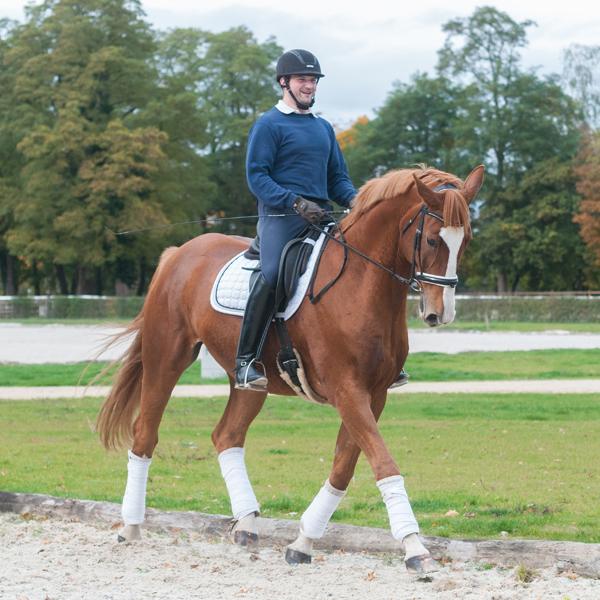
Please do not stand in the stirrups or hold on with your thighs. This will not help you either but will prevent you from sitting the trot well. With both versions, you simply lever yourself out of the saddle and may be thrown back and forth like a bouncy ball. The most important thing about sitting trot is that you stay relaxed in your legs while maintaining positive tension in your core. Your legs should be allowed to hang relaxed. Both your ankles and knees should be flexible. This works best in saddles that have little or no blocks because blocks severely limit your mobility.
Imagine that you are growing upwards away from the saddle like a tree. When in doubt, however, it is better to sit slightly forward rather than lean back. Look where you want to ride and avoid looking at the horse or the ground. Unfortunately, when you look down, you immediately give up your deep and supple seat. Our head is heavy, and as soon as you look down, you also tilt your head. Immediately, tension builds up in your neck and shoulders, and you lock up in your upper joints. However, this also means that your horse’s movement can no longer flow through your body. And your arms also tense up, so that a soft rein connection is no longer possible. So keep your head up and see where you’re going.
Let your arms hang loose and make sure your elbows are bent. If you hold your hands upright in front of you in this way, the connection to your horse’s mouth will be most comfortable for your horse, and it will be able to carry itself best. Let’s get back to your pelvis. As I said, you need a movable pelvis. Sit on a Balimo and see if you can lower the plate onto the ring in all directions. If you don’t have a Balimo, try using an exercise or yoga ball. Can you tilt your pelvis forwards and backwards equally? Does it also go up and down equally to the right and left? When you sit on the ball and move your pelvis, does the ball roll evenly in all directions? If you find that you have problems with this, it may be time to make an osteopathy appointment for yourself. Stretching also helps make you more flexible.
The ultimate tip for sitting out the trot, however, is the following: The next time you have to sit out, imagine you’re sitting on a bike and circling backward. You don’t have to actually move; just imagining it is enough. Your muscles are controlled by your imagination, and if you imagine moving, your muscles will tense and relax so that you can move with your horse and sit with your horse. That’s how you stay relaxed in your legs and have positive tension in your core. Let your legs hang loose, and you’ll find that you can sit the trot a lot better with this idea. Give it a try and let me know how it went. Want more tips for better riding? Follow me on TikTok 🙂








This Post Has 2 Comments
Thx
You actually make it seem really easy with your presentation but I
to find this topic to be really something that I feel
I would never understand. It sort of feels too complicated and very wide
for me. I am having a look ahead to your next put up, I’ll try to get the
dangle of it!